




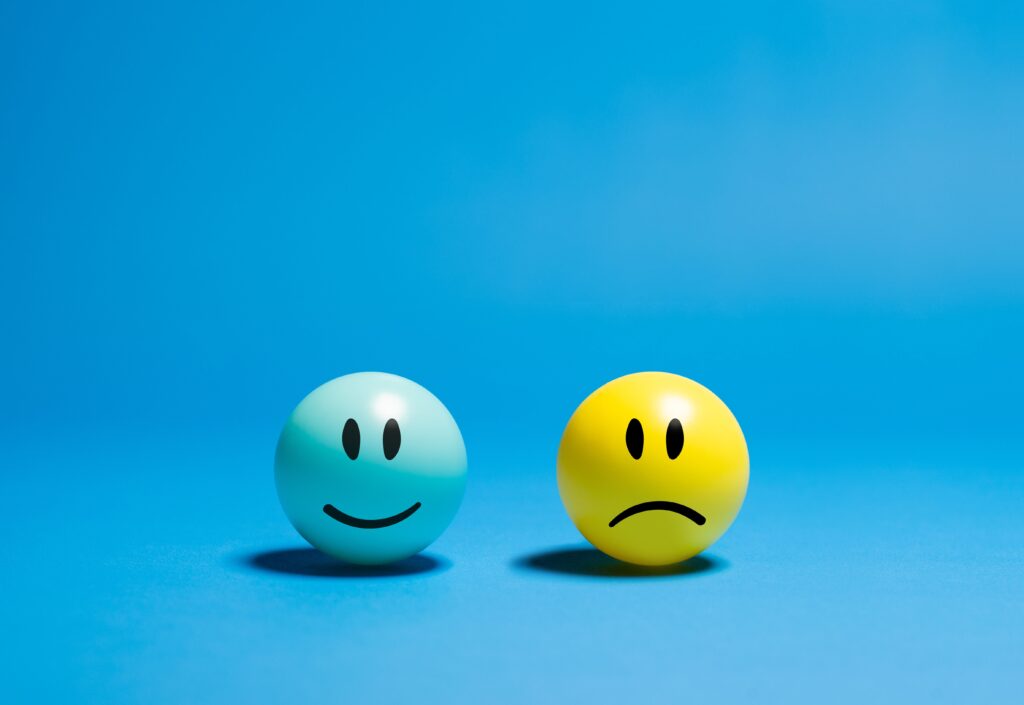
FUNCTIONING WELL DOESN’T MEAN FEELING WELL
Some people always meet their deadlines, always reply to messages on time, and are the colleagues everyone can count on. From the outside, they seem to have it all together. But behind that steadiness, things aren’t always as fine as they look.


When You Have to “Act Fine” Just to Keep Working
The term “high–functioning depression” isn’t an official clinical diagnosis. It’s a popular label for people who experience depressive symptoms while still managing to keep up with work, deadlines, and relationships at a normal level, sometimes even an exceptional one. Clinically, this pattern often overlaps with Persistent Depressive Disorder (dysthymia) – a milder form of depression than major depressive disorder, but one that persists continuously for two years or more.
In 2022, researchers Follmer and Jones published a notable finding in Group & Organization Management based on interviews with employees living with depression: hiding it isn’t a single, simple act. People draw on a range of strategies to manage how they’re perceived at work. Some stay completely silent. Others cover with a different excuse altogether, saying they’re seeing a doctor for headaches rather than a therapy appointment. And some take the hardest strategy to spot out: they keep smiling, keep showing up energized, even as everything underneath feels completely different. A related study by the same authors, published in the Journal of Applied Social Psychology in 2021, found that these choices are usually driven by very specific fears: fear of being seen as unprofessional, fear of it affecting their work, fear of being looked at differently.


Alongside this act of “performing fine,” there’s a quieter mechanism at play: the tendency to downplay how serious things really are. A 2012 study by Farmer, Farrand, and O’Mahen in BMC Psychiatry frames this, through the lens of identity conflict, admitting to depression can feel like giving up a version of yourself and the goals you’re working toward, so many people avoid facing it until they simply can’t anymore. This isn’t rare. A 2017 qualitative synthesis in Qualitative Health Research, drawing on data from 474 people across 20 studies, found that this same avoidance is the most common reason people delay seeking help, regardless of cultural context.
The clearest number behind this mechanism comes from a large-scale 2015 study in the Journal of Occupational and Environmental Medicine: among employees with significant depressive symptoms, more than half – 52.8%, to be exact – didn’t recognize that they needed help at all. In other words, the very ability to “still function normally” becomes the reason people believe they’re fine.
The Cost of Keeping Up Appearances
Constantly showing an emotional front that doesn’t match what you actually feel isn’t free of cost. A 2011 meta-analytic review in the Journal of Occupational Health Psychology found that, across industries, this kind of emotional performance is consistently linked to all three dimensions of burnout: emotional exhaustion, cynicism, and a diminished sense of personal accomplishment.
Always appearing fine also makes it harder for the mind to truly rest. A 2022 study by Cambier and Vlerick in Occupational Health Science found that when the mind can’t disengage from work even after hours, the body’s natural recovery process gets disrupted along with it. On top of that, actively concealing a part of yourself that’s seen as “a problem” has a direct effect on quality of life, both physical and psychological, according to a 2017 study in Social Science & Medicine.
Perhaps the most striking finding is a difficult loop to escape: the more people fear being discriminated against for a mental health issue, the more they tend to hide it. The longer that concealment continues, the heavier the psychological burden becomes. This comes from a 2018 study in Social Psychiatry and Psychiatric Epidemiology. In a sense, the very fear that keeps people from seeking help is what makes the condition worse over time.


Self–Regulation in the Moments That Call for a Clear Head
We don’t always have the luxury of stopping to fully process our emotions, for example, right before an important meeting, or in the middle of a deadline crunch. In those moments, having a few quick techniques to help regulate emotions, even ones that take only seconds to a couple of minutes, can make a real difference. And these techniques are backed by research.
The first is a specific breathing pattern: inhale through your nose until your lungs are full, take one more short sip of air right after, then exhale slowly through your mouth. A 2023 study by a research team at Stanford, published in Cell Reports Medicine, found that just one to three repetitions of this technique lower acute stress faster than standard meditation practices.
The second is naming the exact emotion running through your head right before stepping into a high-pressure situation. You can quietly acknowledge “I’m feeling anxious” instead of trying to push the feeling away. According to a 2018 review in Emotion Review, this simple act helps calm the part of the brain that reacts to strong emotion, freeing up mental space to focus on the task at hand.
The third is reframing that jittery feeling altogether: instead of reading a racing heart as a sign of panic, try treating it as energy that helps you perform better. A 2010 study in the Journal of Experimental Social Psychology, conducted with people preparing for an important exam, found that those coached to reframe their arousal this way performed noticeably better, both on a practice test and on the real exam months later. A similar effect was replicated in a 2016 study conducted in an actual exam-room setting rather than a lab.

When It’s Time to Bring in Professional Support
If there’s one thing worth repeating clearly, it’s this: “still getting things done” is not proof that everything is fine. If anything, as mentioned earlier, it’s often exactly why the problem goes unnoticed the longest.
A few signs are worth paying closer attention to, not as a way to self-diagnose, but as cues for when it might help to bring in a professional perspective. You can notice a sense of sadness or emptiness that persists continuously for more than two weeks; needing noticeably more effort than usual to get through familiar tasks, even when the results on the outside haven’t changed; or a sense of numbness and emotional disconnection even when you’ve achieved something you once wanted.
The good news is that this condition, even in its persistent, “still functioning” form, is highly treatable. Sometimes, the first step is simply allowing yourself to admit that you’re not okay, even though, as this whole piece has shown, that may be the hardest part of all.
Image Source: Pexels
References:
Balban, M. Y., Neri, E., Kogon, M. M., Weed, L., Nouriani, B., Jo, B., Holl, G., Zeitzer, J. M., Spiegel, D., & Huberman, A. D. (2023). Brief structured respiration practices enhance mood and reduce physiological arousal. Cell Reports Medicine, 4(1), Article 100895. https://doi.org/10.1016/j.xcrm.2022.100895
Cambier, R., & Vlerick, P. (2022). When thoughts have no off switch: The cost of telepressure and message-based communication behaviour within boundary-crossing contexts. Occupational Health Science, 6(4), 545-564. https://doi.org/10.1007/s41542-022-00127-7
Dewa, C. S., & Hoch, J. S. (2015). Barriers to mental health service use among workers with depression and work productivity. Journal of Occupational and Environmental Medicine, 57(7), 726-731. https://doi.org/10.1097/JOM.0000000000000472
Doblyte, S., & Jiménez-Mejías, E. (2017). Understanding help-seeking behavior in depression: A qualitative synthesis of patients’ experiences. Qualitative Health Research, 27(1), 100-113. https://doi.org/10.1177/1049732316681282
Farmer, C., Farrand, P., & O’Mahen, H. (2012). “I am not a depressed person”: How identity conflict affects help-seeking rates for major depressive disorder. BMC Psychiatry, 12, Article 164. https://doi.org/10.1186/1471-244X-12-164
Follmer, K. B., & Jones, K. S. (2021). It’s not what you do, it’s why you do it: Motives for disclosure and concealment decisions among employees with depression. Journal of Applied Social Psychology, 51(10), 1013-1037. https://doi.org/10.1111/jasp.12818
Follmer, K. B., & Jones, K. S. (2022). Navigating depression at work: Identity management strategies along the disclosure continuum. Group & Organization Management, 47(5), 963-1007. https://doi.org/10.1177/10596011211002010
Hülsheger, U. R., & Schewe, A. F. (2011). On the costs and benefits of emotional labor: A meta-analytic review. Journal of Occupational Health Psychology, 16(3), 361-389. https://doi.org/10.1037/a0022876
Jamieson, J. P., Mendes, W. B., Blackstock, E., & Schmader, T. (2010). Turning the knots in your stomach into bows: Reappraising arousal improves performance on the GRE. Journal of Experimental Social Psychology, 46(1), 208-212. https://doi.org/10.1016/j.jesp.2009.08.015
Jamieson, J. P., Peters, B. J., Greenwood, E. J., & Altose, A. J. (2016). Reappraising stress arousal improves performance and reduces evaluation anxiety in classroom exam situations. Social Psychological and Personality Science, 7(6), 579-587.
Quinn, D. M., Weisz, B. M., & Lawner, E. K. (2017). Impact of active concealment of stigmatized identities on physical and psychological quality of life. Social Science & Medicine, 192, 14-17.
Torre, J. B., & Lieberman, M. D. (2018). Putting feelings into words: Affect labeling as implicit emotion regulation. Emotion Review, 10(2), 116-124. https://doi.org/10.1177/1754073917742706
Yoshimura, Y., Bakolis, I., & Henderson, C. (2018). Psychiatric diagnosis and other predictors of experienced and anticipated workplace discrimination and concealment of mental illness among mental health service users in England. Social Psychiatry and Psychiatric Epidemiology, 53(10), 1099-1109.